
Why Do I Feel Like I've Lost the Person I Used to Be?
- Lisa Atkins, LCSW
- 1 day ago
- 5 min read

Depression can change more than how you feel. Over time, it can change how you see yourself. You may look back at old photographs, remember the things you used to enjoy, or think about the person you once seemed to be and wonder, “Where did that version of me go?”
When joy, confidence, motivation, and hope become harder to access, it can feel as though depression hasn't simply affected your mood—it has taken away part of who you are. But feeling disconnected from yourself doesn't necessarily mean that person is gone. Sometimes the qualities you miss are still there, even when depression has made them much harder to see.
If you've ever found yourself thinking, “I feel like I've lost the person I used to be,” that feeling can be one of the most painful and confusing experiences of depression.
When You Look Back and Barely Recognize Yourself

One Saturday afternoon...
Michael opened an old box in the hall closet.
Inside...
Were photographs he hadn't looked at in years.

There he was...
Holding his young daughter on his shoulders.
Laughing at a family cookout.
Fishing with friends.
Smiling without thinking about it.

Michael studied the pictures for a long time.
Then quietly whispered,
"I barely recognize that guy anymore."

It wasn't just that he looked younger.
It felt...
Like he had been someone different.
Someone lighter.
Someone who laughed more.
Someone who dreamed about the future.
When You Feel Like You've Lost the Person You Used to Be

He gently placed the photos back into the box.
A heavy thought settled into his mind.
"I think I've lost who I used to be."

That thought stayed with him.
Not for an hour.
Not for a day.
For weeks.
Every difficult day seemed to prove it.
What If the Real You Hasn't Disappeared?

One afternoon...
Michael visited a local art museum.
He wandered quietly through the galleries.
One exhibit showed paintings that had been carefully restored.

Beside one painting...
There was a photograph taken before the restoration.
The colors looked dull.
Dark stains covered much of the canvas.
Cracks ran across the surface.
It was hard to imagine...
How beautiful it truly was.

Then Michael looked at the restored painting.
The colors hadn't been painted from scratch.
They had always been there.
The restoration hadn't created the artwork.
It had simply uncovered it.
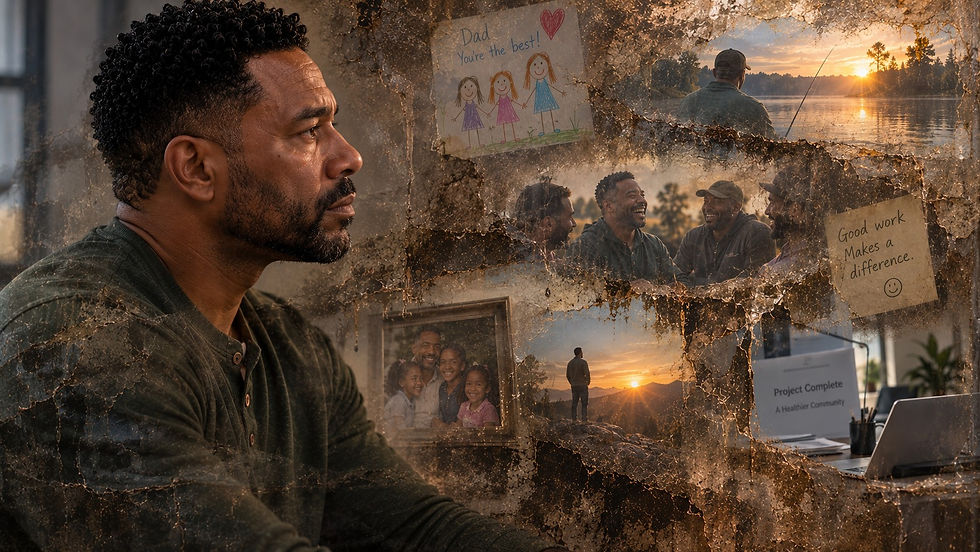
Depression can sometimes feel like those years of dust and grime.
Joy becomes harder to reach.
Hope becomes quieter.
Confidence fades.
You begin wondering...
Whether the real you has disappeared.

But what if...
The person Michael missed...
Hadn't actually vanished?
What if...
Depression had simply covered parts of him...
That had once come naturally?
Depression Can Cover Parts of You Without Erasing Them

He thought about everything that had happened over the past year.
He still loved his children.
He still cared deeply about other people.
He still noticed when coworkers were struggling.
He still showed kindness.
Those parts of him...
Had never left.
They had simply become harder to see.

Michael realized something surprising.
The man in the photographs...
Wasn't gone.
He had been quietly surviving...
Beneath layers of exhaustion...
Sadness...
Self-doubt...
And hopelessness.
Healing Doesn't Have to Mean Becoming Your Old Self Again

Healing wasn't about becoming someone new.
It wasn't about pretending the hard years never happened.
It was about slowly uncovering...
The parts of himself...
That depression had hidden...
But never destroyed.

Healing didn't begin the day Michael became the man he used to be.
Healing began the day he stopped searching for a lost person...
And started rediscovering...
The one who had been there all along.
Little by little...
He laughed more often.
He noticed beauty again.
He looked forward to seeing his children.
He began making plans instead of simply getting through the day.
Not because depression had erased every difficult moment.
But because it no longer got to decide...
Who Michael was.
Because Michael discovered something he wished someone had told him years earlier...
Depression can cover parts of you.
It can quiet your laughter.
It can dim your hope.
It can make you question your own identity.
But it cannot erase...
The person underneath.
Sometimes healing isn't becoming someone different.
Sometimes healing...
Is coming home to yourself.
Reflections: Finding Yourself Beneath Depression

One of the most unsettling parts of depression can be the feeling that it has changed not only your mood, but your identity. You may remember being more spontaneous, hopeful, interested, confident, or excited about the future and conclude that the person who had those qualities is gone. But depression can reduce your access to those experiences. When laughter no longer comes easily or hope feels distant, the mind can mistake “I can't feel this part of myself right now” for “This part of me no longer exists.” Those are not the same thing. The story's covered-painting metaphor asks us to consider another possibility: some parts of you may have become obscured without ever being erased.

Depression can make feelings an unreliable measure of identity. You may not feel loving when you are emotionally numb. You may not feel like a good friend when responding to a message takes enormous effort. You may not feel compassionate when you barely have enough energy for yourself. This is why it can help to look beyond emotion and notice what continues to matter to you. The concern you have for someone, the small kindness you still offer, the love that remains even when you cannot fully feel it—these can be evidence of continuity. Your emotional access to yourself may have changed while some of your deepest values remained remarkably intact.

Missing who you used to be can quietly turn recovery into a comparison you can never win. Every good day gets measured against an earlier version of you: Am I laughing like I used to? Am I as energetic? Do I feel like that person yet? But healing does not require reversing time. The difficult years happened, and they may have changed you in meaningful ways. Recovery can instead involve reconnecting with qualities that became harder to access while also making room for the person your experiences have helped you become. Michael doesn't need to recreate the man in the old photographs. He can carry forward his love, humor, kindness, hope, and capacity for connection while becoming fully present in the life he has now. Coming home to yourself doesn't mean returning to the past. It means recognizing yourself again in the present.
If depression has left you wondering where the person you used to be went, you don't have to measure healing by how closely you can recreate an earlier version of yourself. The parts of you that feel distant may not be gone. Your capacity for connection, hope, enjoyment, confidence, and purpose can become harder to reach during depression without being permanently erased. Therapy for depression can give you a place to understand what depression has changed, reconnect with what still matters to you, and begin discovering who you are now—not by forcing yourself backward, but by slowly finding your way home to yourself.


Comments