
Why Do I Keep Canceling Plans with People I Care About?

You make the plans because you genuinely want to go. You like the people. You can picture yourself laughing, talking, and enjoying the evening. But when the day finally arrives, something has changed. Getting dressed feels harder. Driving there feels farther. Conversation feels like it will require energy you simply don't have. So, you cancel—and then wonder why you're sitting at home wishing you had gone. Canceling plans because of depression doesn't necessarily mean you've stopped wanting connection.
Michael's story explores a side of depression that can be easy to misunderstand: sometimes the desire for connection is still there, even when the emotional energy required to reach it isn't.
When You Really Did Want to Go

It was Wednesday afternoon.
Michael's phone buzzed.
It was a message from his friend, James.
"A few of us are getting together Friday night.
You coming?"

Michael smiled.
He liked James.
He liked everyone who would be there.
For a moment...
He even imagined himself going.
Laughing.
Talking.
Having a good evening.

He typed,
"Sounds good. I'll be there."
Pressed send.
And went back to work.
When the Energy Changes but the Plan Doesn't

By Friday afternoon...
Everything had changed.
The workweek had felt long.
His body felt heavy.
His mind felt tired.
The idea of getting dressed...
Driving across town...
Making conversation...
Somehow felt overwhelming.
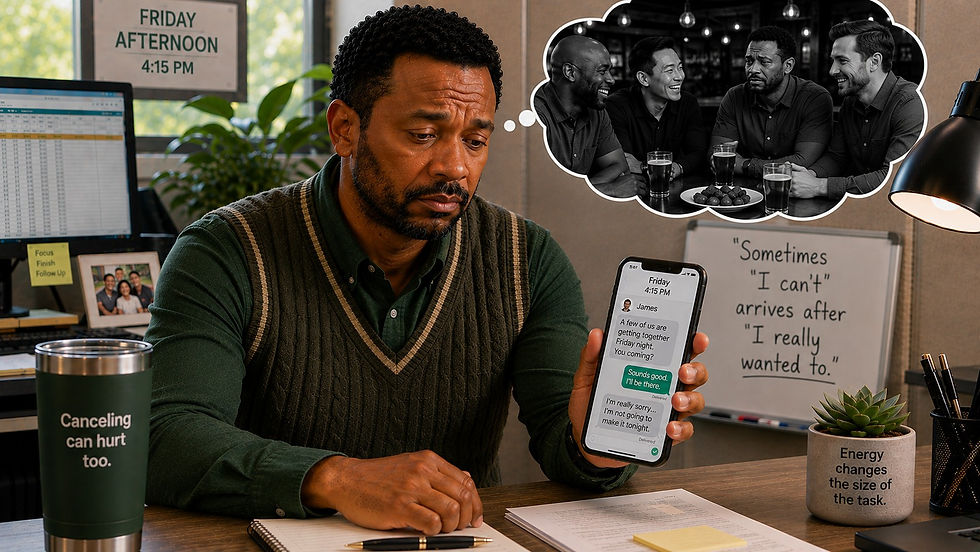
He picked up his phone.
Stared at the message.
Typed,
"I'm really sorry...
I'm not going to make it tonight."
He pressed send.
Then quietly set the phone down.
When Canceling Doesn't Feel Like Relief

A few minutes later...
James replied,
"No problem.
Maybe next time."
Michael appreciated the kindness.
But he also wondered...
"How many 'next times' before people stop asking?"

He wasn't relieved that he canceled.
He was disappointed.
He had wanted to go.
He had wanted to be the person...
Who wanted to go.

Later that evening...
He looked at pictures his friends had posted.
They were laughing.
Eating dinner.
Having a great time.
Michael smiled.
Then quietly whispered,
"I wish I had been there."

He wondered,
"Why do I keep canceling plans...
with people I actually care about?"
If You Want the Destination, Why Can't You Make the Trip?

That Friday night was over, but Michael knew
it wouldn't be the last time someone invited him somewhere.
There would be another dinner, another text,
another opportunity to spend time with people
he genuinely cared about. And that raised an important question:
If Michael still wanted the friendship,
why was getting there sometimes so difficult?
To understand the difference between wanting connection
and having the capacity for it, it may help to imagine his experience another way.
Canceling Plans Because of Depression: When the Destination Hasn't Changed

Imagine planning a road trip.
You know exactly where you want to go.
You even enjoy the destination.
But just before leaving...
You look down...
And notice the gas gauge.
It's almost empty.

You don't cancel the trip...
Because you dislike the destination.
You cancel it...
Because you aren't sure...
You have enough fuel...
To make the drive.

Depression can sometimes feel like that.
Michael still loved his friends.
He still valued connection.
He still wanted to laugh.
But his emotional tank...
Often felt nearly empty...
Before the evening even began.
What Canceling Plans Doesn't Tell You

People looking from the outside...
Might assume...
"He's pulling away."
"He doesn't care anymore."
The truth was almost the opposite.
Michael cared so much...
That disappointing people...
Made him feel even worse.

For a long time...
Michael believed canceling meant he was becoming a bad friend.
But what if...
He wasn't choosing isolation?
What if...
He was simply trying to function...
With very little emotional fuel?
That didn't make him uncaring.
It made him someone who was struggling.
The Journey Got Harder. The Destination Never Changed.

Healing didn't begin the first time Michael never canceled another invitation.
Healing began the day he stopped confusing...
His depression...
With his desire for connection.
Little by little...
He learned to recognize that the part of him wanting friendship...
Had never disappeared.
Some days...
His tank was too low.
Other days...
He found enough fuel to show up.
And every time he did...
He was reminded of something important.
Depression had made the journey harder.
It had never changed...
Where his heart wanted to go.
What Michael's Story Can Help Us Understand About Depression

Depression can create a painful gap between what you want and what you have the emotional capacity to do. You may care about your friendships, look forward to plans when you make them, and still find that by the time the day arrives, getting dressed, driving somewhere, talking, and staying socially engaged feels much harder than you expected. Canceling doesn't necessarily reveal how much the relationship matters to you. Sometimes it reveals how little emotional fuel you had available when it was time to show up.

It's easy to assume that someone who repeatedly cancels plans must prefer being alone. But depression-related withdrawal doesn't always feel comforting. You can stay home and still miss the people you didn't have the energy to see. In fact, the disappointment you feel afterward may tell you something important: the connection still matters. The problem may not be that you've stopped wanting relationships. It may be that depression has made reaching them more difficult.

When canceling happens repeatedly, the depressed mind can turn a struggle with capacity into a judgment about identity: “I'm unreliable. I'm a bad friend. I'm becoming antisocial.” But behavior tells us what happened; it doesn't always tell us why.
You can take responsibility for communicating with people and caring for your relationships without turning every difficult day into evidence about who you are. Some days you may have enough emotional fuel to show up. Other days you may not. The journey can become harder without changing where your heart wants to go.
If you've found yourself repeatedly canceling plans with people you care about, it can be tempting to treat every canceled invitation as evidence about the kind of person you've become. But there may be another question worth asking.
Instead of only asking, “Why do I keep pulling away?” you might also ask, “Do I still want the connection, but sometimes lack the emotional energy to reach it?” Those are very different experiences. Depression can make the journey toward other people feel much longer and more demanding than it once did. Understanding that doesn't mean relationships no longer require communication, care, or effort. It means you don't have to turn every struggle with capacity into a verdict about your character. Sometimes the tank is low even when your heart is still pointed toward the same destination.
If depression is making it harder to stay connected to the people and parts of life that matter to you, depression therapy can help you understand what you're experiencing and begin finding your way back to them.


Comments