
Why Don't I Enjoy Things Anymore?

When people think about depression, they often think about sadness. But sometimes depression shows up differently. You may still care about the people in your life. You may remember what you used to enjoy. You may even want to feel excited about those things again—and yet the feeling simply doesn’t arrive.
This loss or reduction in the ability to experience pleasure is sometimes called anhedonia, and it can leave people wondering, “What happened to me?”
People sometimes begin searching for answers when they realize, “I don't enjoy things anymore,” even though they still care about the people and activities that once brought them joy.
Michael’s story explores what it can feel like when the things that once brought life, connection, and enjoyment are still there—but somehow feel much harder to reach.
When You Don't Enjoy Things Anymore

It was Friday evening.
For years...
Friday had been Michael's favorite night of the week.
He used to look forward to it.
Ordering takeout.
Watching a game.
Calling his kids.
Maybe even meeting a friend for dinner.

Tonight...
He sat quietly on the couch.
The television was on.
His favorite team was playing.
But after a few minutes...
He realized...
He wasn't really watching.

His phone buzzed.
It was a text from an old friend.
"A few of us are grabbing dinner tonight. Want to come?"
Michael stared at the message.
He wanted to want to go.
But instead...
He typed,
"Maybe next time."

Later that evening...
He looked at a photo on his bookshelf.
It was from a camping trip years ago.
He remembered laughing around the fire.
Fishing with his kids.
Telling stories late into the night.
He smiled...
But only because he remembered enjoying it.
Not because he felt that enjoyment now.

The next morning...
He decided to work in the yard.
He used to love being outside.
The smell of fresh-cut grass.
The warmth of the sun.
The satisfaction of finishing a project.
Today...
It all felt strangely flat.
Nothing was wrong.
Nothing terrible had happened.
But nothing seemed to spark...
The feeling it once did.

That afternoon...
Michael began wondering why he didn't enjoy things anymore, even though he still cared about the people and activities that had always mattered to him.
What If the Music Is Still Playing?

Then he remembered something from his old truck.
Years ago...
The radio had started acting up.
The songs were still playing.
But somehow...
Everything sounded quieter.
The music hadn't changed.
The singers hadn't changed.
The radio station hadn't changed.
Only the volume had.

Depression can sometimes feel like that.
The things you once loved...
May still be there.
Your favorite food.
Your hobbies.
Your family.
Your friends.
But it's as though...
The volume has been turned down.
You Can't Always "Try Harder" Your Way Back to Joy

People sometimes assume...
"If you just went out more..."
"If you just smiled..."
"If you just tried harder..."
You'd enjoy life again.
But that's like telling someone...
To enjoy music...
When they can barely hear it.
Feeling Less Isn't the Same as Caring Less

Michael wasn't losing interest because he didn't care.
He cared deeply.
He loved his children.
He valued his friendships.
He wanted to enjoy life.
Depression had simply made it harder...
To feel what was still there.

For a long time...
Michael blamed himself.
"Maybe I'm becoming boring."
"Maybe this is just who I am now."
But what if...
He wasn't losing himself?
What if...
Depression had simply turned the volume down...
On the parts of life that once brought him joy?
Quiet Doesn't Mean Gone

That realization changed something.
It meant joy wasn't necessarily gone forever.
It might simply be...
Harder to hear right now.
Like a song...
Still playing softly...
Waiting for the volume to return.

Healing didn't begin the day Michael suddenly felt excited again.
Healing began the day he stopped believing...
That the silence meant the music was gone.
Little by little...
He stayed connected to the people he loved.
He kept showing up...
Even when the feelings lagged behind.
Because he discovered something hopeful...
Depression could turn the volume down.
But it couldn't erase the music.
And somewhere beneath the quiet...
The song of his life...
Was still playing.
A Few Things to Reflect On
Reflection #1: Wanting to feel joy is evidence that something still matters to you.

When depression makes pleasure difficult to access, it can be easy to assume that you've stopped caring or that an important part of you has disappeared. But wanting to enjoy your relationships, interests, or activities—and feeling frustrated that you can't—can tell a different story. The connection may still matter deeply, even when the emotional response is difficult to reach right now.
Reflection #2: Participation and pleasure are not the same thing.
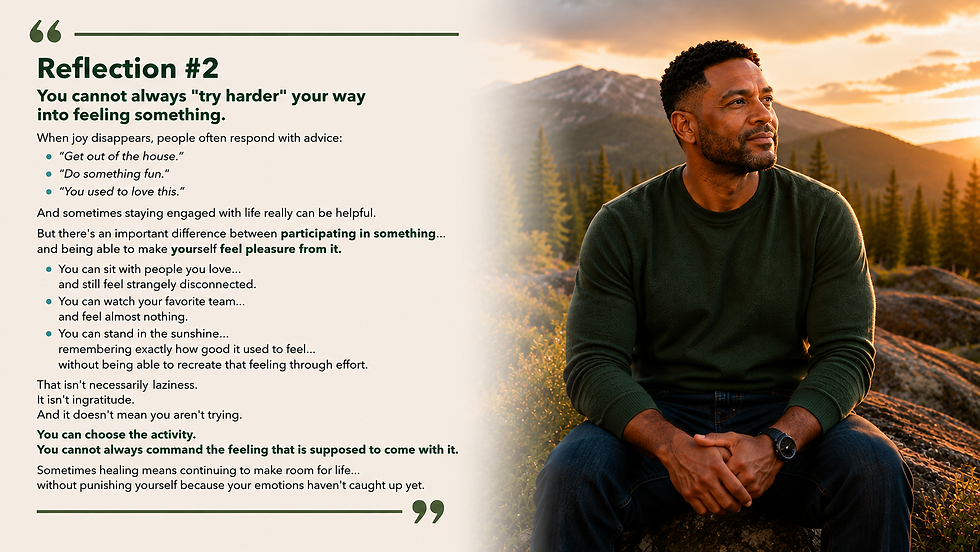
Participation and pleasure are not the same thing.
You can choose to spend time with people you love, go outside, return to an old hobby, or keep participating in your life. What you cannot always do is command your brain to produce the feeling you think should accompany those experiences. Continuing to make room for life can matter—but struggling to feel enjoyment doesn't mean you're lazy, ungrateful, or not trying hard enough.
Reflection #3: What feels absent today does not automatically predict what you will be capable of feeling tomorrow.

When emotional quiet lasts for a long time, the mind can begin turning “I don't feel it right now” into “I'll never feel it again.” Those are not the same statement. You don't have to force joy to return or pretend you're feeling something you're not. Sometimes hope begins more quietly—with leaving open the possibility that this part of you hasn't disappeared. It may simply be harder to hear right now.
You Haven't Necessarily Lost the Part of You That Used to Feel Joy
If you've found yourself thinking, “I don't enjoy anything anymore,” it can be frightening to wonder whether you've changed permanently. But emotional quiet doesn't necessarily mean that the things you love—or your capacity to experience them—are gone. Depression can affect the way pleasure, motivation, interest, and connection are experienced. You don't have to force yourself to feel better or prove that you're trying hard enough. Sometimes healing begins with understanding what is happening, treating yourself with less judgment, and allowing someone to help you find your way toward the parts of life that have become difficult to hear.
If some of Michael’s experiences feel familiar, learn more about how therapy for depression can help you understand what you’re experiencing and begin finding your way forward.


Comments