
Why Do I Feel Numb Sometimes?

Emotional numbness after trauma can be difficult to understand because it doesn't always look like distress. You may still go to work, talk with people you care about, laugh at the right moments, and recognize that something should feel meaningful—yet inside, everything seems strangely quiet.
For some people who have experienced trauma or prolonged emotional overwhelm, numbness can be less about having no feelings and more about a nervous system that has learned to reduce their intensity. Emma's story explores what can happen when a response that once helped protect us begins to feel as though it has disconnected us from our own lives.
When You Know Something Should Feel Good—but You Can't Feel It

It was Sunday afternoon.
Emma was walking through the garden center before opening.
The roses were blooming.
Butterflies drifted between the flowers.
Morning sunlight filled the greenhouse.
It was beautiful.

She knew it was beautiful.
She could see it.
She could even appreciate it.
But she couldn't...
Feel it.

It was as though someone had quietly turned down the volume...
On everything inside her.
Not just happiness.
Everything.

Later that afternoon...
Her sister called.
They laughed.
Shared stories.
Talked about family.
Emma smiled throughout the conversation.
When she hung up...
The quiet returned.
Almost immediately.
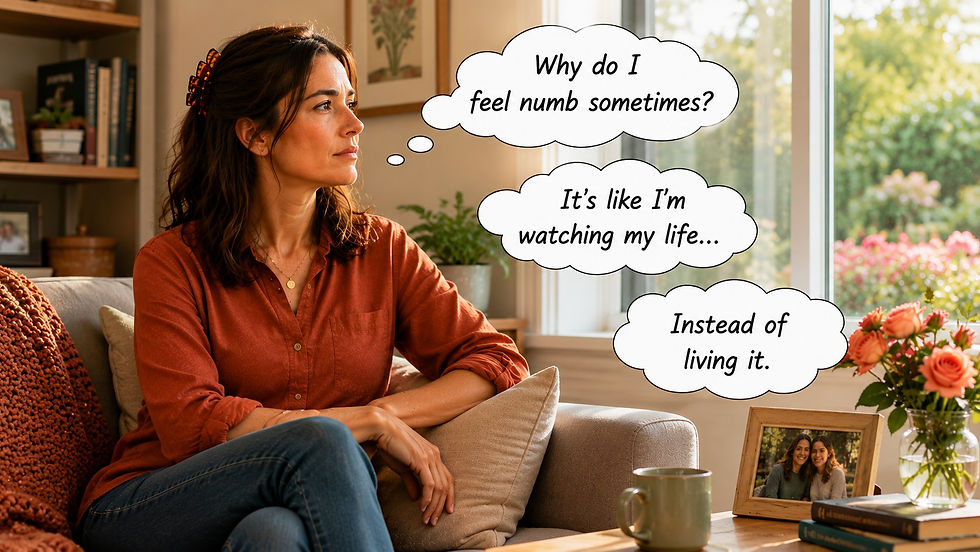
She sat on the couch...
Looking out the window.
And softly asked,
"Why do I feel numb sometimes?"
"It's like I'm watching my life..."
"Instead of living it."

The feeling scared her.
She wasn't crying.
She wasn't panicking.
She wasn't overwhelmed.
She simply...
Didn't feel very much at all.
What If Numbness Is a Protective Response?

A few days later...
A thunderstorm rolled through town.
The power suddenly went out at her house.
Every light turned off.
Everything became still.

When she checked the electrical panel...
One circuit breaker had flipped.
The electrician later explained,
"It shut itself off..."
"To protect the system from too much overload."

Emma thought about that for a long time.
The breaker hadn't failed.
It had responded...
To more than the system could safely handle.

Trauma can sometimes affect our nervous system in a similar way.
When emotions become overwhelming...
The nervous system may temporarily lower the intensity.
Not because it doesn't care.
Because it's trying to protect us...
From becoming overloaded.
Why Emotional Numbness After Trauma Can Affect More Than Pain

The difficult part is...
It often lowers everything.
Joy.
Excitement.
Connection.
Peace.
Not only the painful emotions.

People looking at Emma...
Sometimes assumed she seemed distant.
Quiet.
Uninterested.
They couldn't see...
That inside...
Her emotional circuit breaker had quietly switched off...
To help her survive.
When Feeling Begins to Return

For a long time...
Emma believed numbness meant she'd lost herself.
That maybe...
She'd forgotten how to feel.
But perhaps...
Her feelings hadn't disappeared.
Perhaps...
Her nervous system had simply turned the volume down...
Until it believed she was safe enough...
To turn it back up again.

That realization brought unexpected relief.
Instead of forcing herself to feel something...
She became patient.
She noticed small moments.
The warmth of her coffee mug.
The scent of lavender.
The softness of the evening breeze.
Tiny experiences...
That gently reminded her body...
It was okay to begin feeling again.

Healing didn't begin the day Emma suddenly felt every emotion again.
Healing began the day she stopped believing...
That numbness meant she was broken.
Little by little...
Her nervous system discovered...
It didn't have to stay in protection mode forever.
The circuit breaker...
Didn't stay off forever.
It reset...
When the system was ready.
And Emma discovered something she wished someone had told her years earlier...
Feeling numb...
Doesn't mean you've stopped caring.
Sometimes...
It means your nervous system has been carrying...
More than anyone could see.
And with safety...
Compassion...
And time...
Feeling can slowly return...
One quiet moment at a time.
Reflections

After overwhelming experiences, emotional numbness can sometimes function like a circuit breaker. What feels like “I don't care anymore” may actually reflect a nervous system attempting to reduce emotional intensity when too much has been happening at once. Understanding numbness this way doesn't mean assuming every experience of numbness comes from trauma. It simply creates another possibility: rather than immediately treating the absence of feeling as evidence that something is wrong with you, you can become curious about what your system may have been trying to manage.

One of the hardest parts of emotional numbness is that the nervous system may not neatly separate emotions into those you want to feel and those you don't. Protection from painful intensity can sometimes create distance from pleasurable experiences as well. Laughter may feel quieter. Relationships may feel farther away. Things you normally enjoy may seem strangely flat. That doesn't necessarily mean you've lost your capacity for joy, love, or connection. Those feelings may still exist even when you cannot access them at their usual intensity.

Recovery from emotional numbness doesn't have to look like suddenly experiencing every emotion again. Sometimes the earliest changes are so small they are easy to overlook: enjoying one sip of coffee, noticing a familiar scent, feeling comforted by someone's presence, or realizing that something made you smile. These moments can become gentle experiences of reconnection. Rather than measuring healing by how intensely you feel, it may be more helpful to notice the small moments when your mind and body begin allowing you to experience the world again.
Emotional numbness doesn't necessarily mean that your feelings are gone or that you've stopped caring about the people and experiences that matter to you. Sometimes, after trauma or prolonged emotional overwhelm, becoming less emotionally responsive may be one way the nervous system tries to reduce what feels like too much.
Reconnection may happen gradually—not by demanding that you feel differently, but through small experiences of safety, sensation, connection, and compassion. Like Emma, you may begin to discover that the parts of you that seemed absent were not necessarily lost. They may have been waiting for enough safety to become easier to reach again.
If trauma has left you feeling emotionally numb, disconnected, or unlike yourself, our Trauma Therapy services can help you better understand these protective responses and begin finding a path toward reconnection.


Comments