
Why Can't I Relax Even When I'm Safe?

You can know that you're safe and still feel as though your body is waiting for something to happen. If you can't relax even when safe, it can be confusing to understand why your body still feels tense, watchful, or unable to fully settle. The doors are locked. The people around you are safe. Nothing is wrong in this moment—and yet your shoulders tighten, your breathing changes, or your stomach knots.
For people who have experienced trauma, this disconnect can be especially confusing. Emma's story explores what may be happening when your mind recognizes safety, but your nervous system hasn't quite gotten the message.
When Your Mind Says “Safe” but Your Body Says “Danger”

It was Saturday evening.
Emma had just finished another long day managing the garden center.
She kicked off her work boots.
Made a cup of tea.
Curled up on the couch.
Everything was finally quiet.

The doors were locked.
The lights were on.
Soft music played in the background.
Her apartment felt warm.
Comfortable.
Safe.

And yet...
Her shoulders stayed tight.
Her jaw remained clenched.
Her breathing felt shallow.
She couldn't understand why her body refused to settle.

She tried watching television.
Read a few pages of a book.
Scrolled through her phone.
Nothing helped.
Inside...
She still felt like she was waiting...
For something bad to happen.
Why You Can't Relax Even When Safe

Finally she sighed.
"Why can't I just relax?"
"I'm safe."
"So why doesn't my body know that?"

The question followed her to work the next morning.
As she watered flowers in the greenhouse...
She noticed how peaceful everything looked.
Sunlight filtered through the glass.
Birds chirped outside.
Customers smiled as they browsed.
Still...
Her body felt ready for an emergency that wasn't happening.
The Security Alarm That Learned to Watch Too Closely

Years earlier...
A neighbor had installed a home security system after their house had been broken into.
For months afterward...
Even the smallest sound would trigger the alarm.
A tree branch.
A strong gust of wind.
A curious cat.
The alarm wasn't broken.
It had become extremely sensitive.
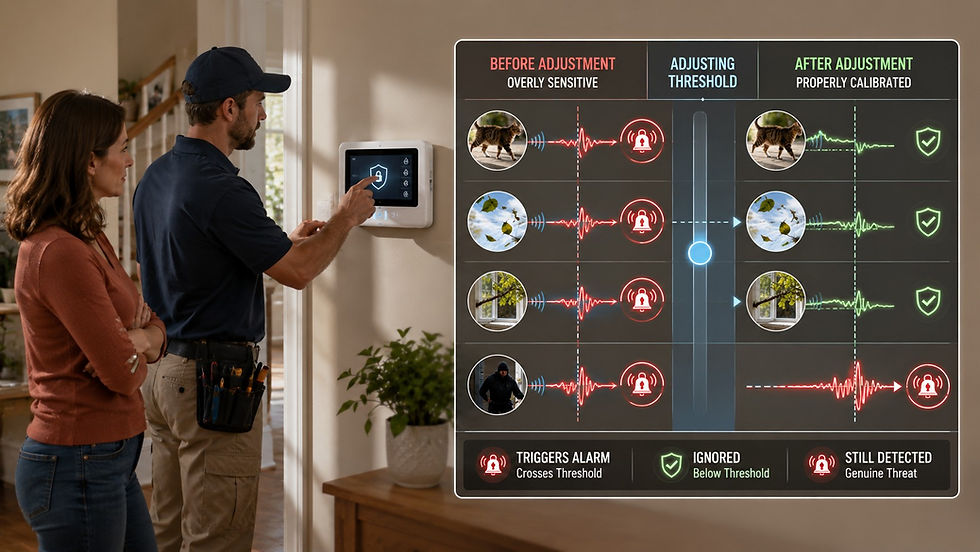
Eventually...
The system was adjusted.
Not because safety no longer mattered.
But because it had begun reacting...
To things that weren't actually dangerous.

Emma wondered...
Could her nervous system be doing something similar?
Could it be trying so hard to protect her...
That it had become sensitive to things...
That no longer meant danger?
When Protection Continues After the Danger Is Over

Trauma can sometimes affect us that way.
After something frightening happens...
Your nervous system learns one powerful lesson:
"Never let that happen again."
So it stays alert.
Even after you're safe.

That doesn't mean you're weak.
It doesn't mean you're "overreacting."
And it doesn't mean you're choosing to stay anxious.
It means your body learned...
To protect you...
The best way it knew how.
The Invisible Security System No One Else Can See

People looking at Emma...
Saw a capable young woman.
Confident.
Responsible.
Calm.
They couldn't see...
The invisible security system inside her...
Working around the clock.

For a long time...
Emma thought something was wrong with her.
"Normal people don't feel like this."
But maybe...
Her body wasn't broken.
Maybe...
It was still trying to do yesterday's job...
In today's world.
A Kinder Question: What Is My Nervous System Trying to Protect?

That realization changed something.
She stopped asking,
"What's wrong with me?"
And started asking,
"What is my nervous system trying to protect me from?"
It wasn't the final answer.
But it was a kinder question.
Safety Is Something the Body Slowly Relearns

Healing didn't begin the day Emma suddenly felt relaxed.
Some days...
Her body still stayed on high alert.
Healing began the day she stopped fighting her nervous system...
And started understanding it.
Little by little...
She learned that safety isn't something we only think about.
It's something our bodies slowly relearn...
One safe experience at a time.
Because Emma discovered something she wished someone had told her years earlier...
Her nervous system wasn't her enemy.
It was a faithful protector...
That had simply forgotten...
The danger was over.
And with patience...
Compassion...
And time...
It could learn to feel safe again.
Three Things to Remember About Trauma and Feeling Safe

We often assume that once we know we're safe, our bodies should immediately relax. But the nervous system doesn't operate only through conscious thought. After frightening or overwhelming experiences, it may continue preparing for danger even when your present circumstances are safe. That's why telling yourself “There's nothing to worry about” may not automatically release the tension in your body. Your thinking brain may understand the present while your protective system is still responding to what it learned in the past.

After something frightening happens, becoming more sensitive to possible danger can make sense. The nervous system learns from experience, and one of the lessons it may carry forward is “Never let that happen again.” The difficulty is that a protective system can begin responding not only to actual danger, but also to ordinary experiences that resemble something it once learned was unsafe. This reframes hypervigilance: instead of asking why your body is overreacting, you can begin wondering what it learned to watch for—and why.

Healing doesn't require getting rid of the part of you that learned to protect you. The goal isn't to become a person who never notices danger or never feels anxious. Instead, repeated experiences of being safe can gradually give the nervous system new information. Over time, it can become better at distinguishing “This reminds me of danger” from “Danger is happening now.” That's why progress may occur in small moments rather than one dramatic breakthrough. The protective system isn't being defeated—it is being updated by the life you're living now.
If your body sometimes reacts as though danger is present even when you know you're safe, perhaps the question isn't “Why can't I just get over this?” Your nervous system may be responding to lessons it learned when being alert really did matter. Healing doesn't have to mean fighting those reactions or forcing yourself to relax. It can mean becoming curious about what your body learned, understanding the protection underneath the anxiety, and slowly giving your nervous system new experiences of safety. Trauma therapy can provide a supportive place to understand these responses and begin helping your mind and body recognize when the danger has passed. Over time, the alarm doesn't have to disappear. It can learn that what once meant danger does not always mean danger now.



Comments