
Why Do I Always Ruin My Diet?

Have you ever eaten something you hadn't planned to eat and immediately thought, “Well, I ruined my diet”? Sometimes the food itself isn't what turns one moment into an entire evening—or an entire day—of eating. What happens afterward can matter just as much: disappointment, self-criticism, and the belief that because you already “messed up,” there is no reason to stop. Angela's story explores what can happen when one unplanned choice becomes evidence that you've failed—and what changes when you begin to see that one moment doesn't have to decide what happens next.
Why One Unplanned Food Choice Can Feel Like You Ruined Your Diet

It was Monday morning.
Angela felt hopeful.
She had grocery shopped over the weekend.
Prepared healthy lunches.
Filled the refrigerator with foods that supported her goals.
She smiled.
"This week is going to be different."

For three days...
Everything went exactly as planned.
She packed her lunch.
Skipped the office donuts.
Drank more water.
She felt proud of herself.

Then Thursday afternoon arrived.
A coworker walked into the break room carrying a box.
"Happy Birthday!"
Cupcakes.
Everyone gathered around.
Someone handed one to Angela.
She hesitated...
Then took a bite.

It tasted wonderful.
But almost immediately...
A familiar thought appeared.
"Great..."
"I ruined my diet."

By dinner...
That one cupcake had become...
Fast food.
Dessert.
And several handfuls of chips while watching television.
As she got ready for bed...
Angela quietly whispered,
"Why do I always ruin my diet?"
Understanding All-or-Nothing Thinking Around Food

Saturday morning...
She was driving to visit her parents.
About halfway there...
She hit a nail.
The tire slowly went flat.

She pulled safely to the side of the road.
The roadside assistance technician arrived.
He changed the tire.
Twenty minutes later...
Angela was back on the highway.

As she drove...
She laughed to herself.
She couldn't imagine saying,
"Well..."
"One tire went flat..."
"I might as well ruin the other three."
That would make no sense.

Then something clicked.
Maybe eating worked the same way.
Maybe...
One cupcake...
Was only one flat tire.
It wasn't the end of the trip.
Unless she decided it was.
How Self-Criticism Can Keep the Emotional Eating Cycle Going

Sometimes...
The most difficult part isn't the first unplanned choice.
It's the story we tell ourselves afterward.
"I failed."
"I ruined everything."
"I'll start over Monday."
Those thoughts often create...
Far more overeating...
Than the cupcake ever could.

That doesn't mean...
Goals don't matter.
Or that healthy eating isn't important.
It means...
One moment...
Doesn't erase...
Every other healthy choice you've made.
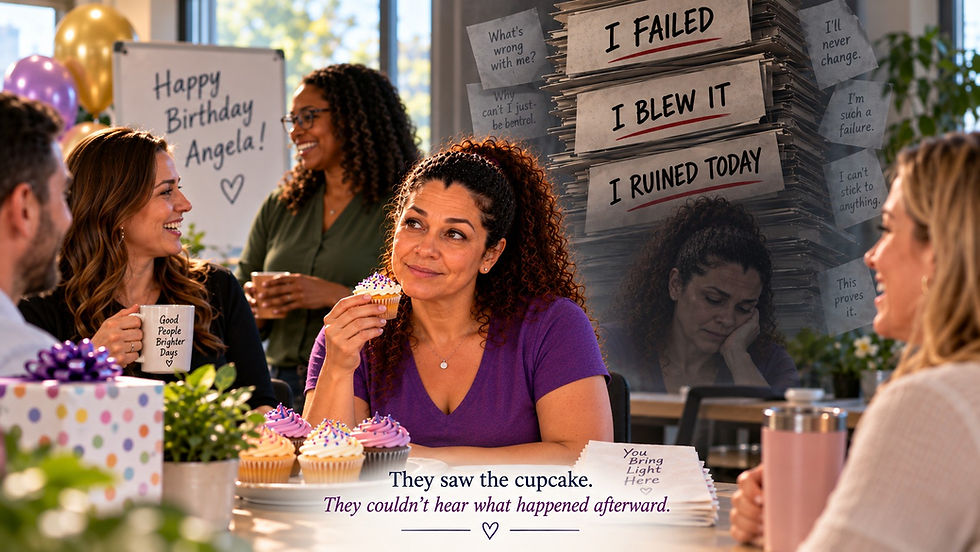
People looking at Angela...
Only saw her eating a cupcake.
They couldn't hear...
The harsh voice inside her...
Turning one small decision...
Into an entire day...
Of self-criticism.

For years...
Angela believed...
Her problem was eating the cupcake.
But maybe...
The bigger problem...
Was believing...
That one cupcake...
Defined the whole day.
Moving From “I Ruined My Diet” to “What’s My Next Choice?”
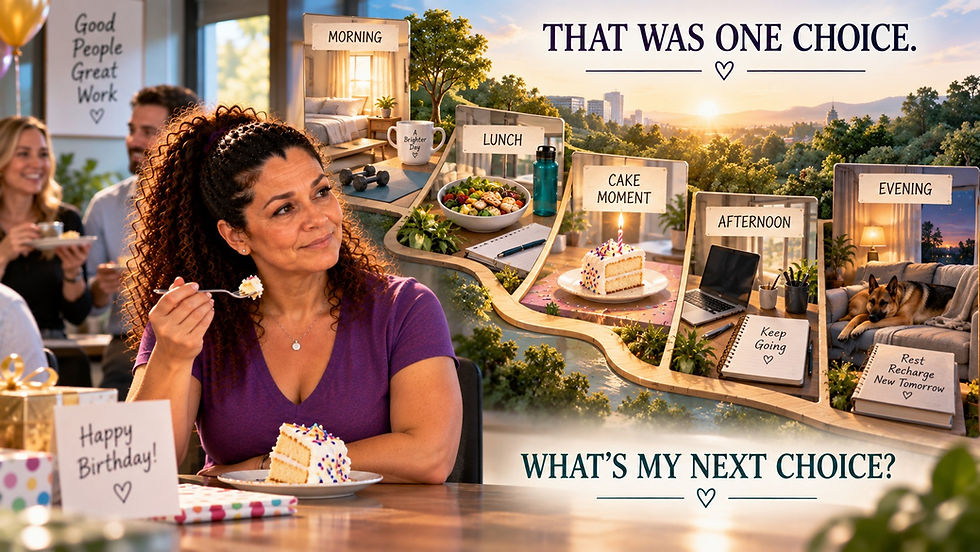
The following week...
Another birthday arrived.
Another dessert appeared.
Angela smiled.
She enjoyed a piece of cake.
Then quietly thought,
"That was one choice."
"Now..."
"What's my next choice?"
She packed up her lunch.
Finished her workday.
And went home.
The day kept going.
Just like before.

Healing didn't begin the day Angela stopped eating birthday cake.
Life still included celebrations.
Vacations.
Holidays.
And unexpected treats.
Healing began the day she stopped believing...
That one imperfect moment...
Had the power...
To erase every healthy choice...
That came before it.
Little by little...
She stopped asking,
"Did I ruin today?"
And started asking,
"What would I like my next choice to be?"

Because Angela discovered something she wished someone had told her years earlier...
A flat tire...
Doesn't end the journey.
It simply asks you...
To make one adjustment...
And keep driving.
And healing isn't built...
By having perfect days.
It's built...
One next choice...
At a time.
Emotional Eating Reflection: When One Moment Feels Bigger Than It Is
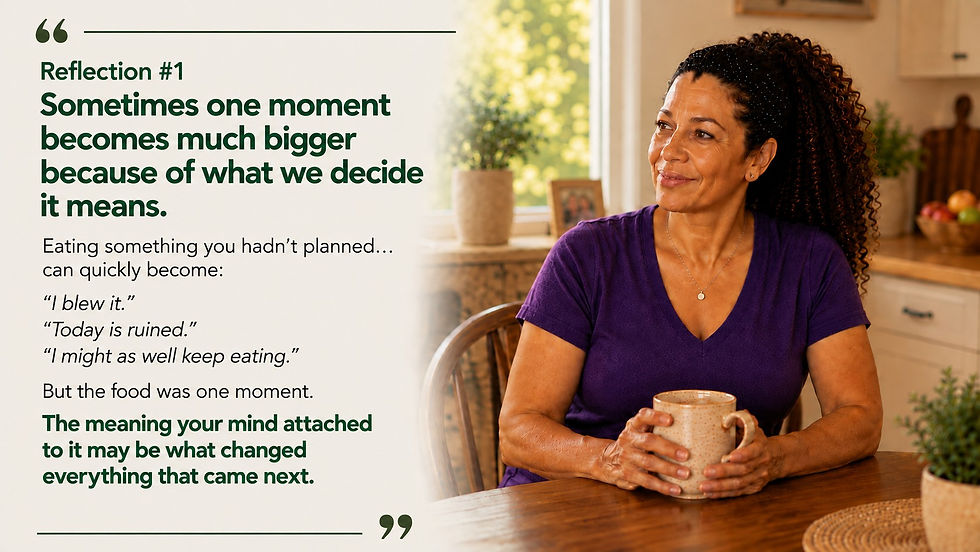
Our minds are constantly interpreting what happens, often so quickly that the interpretation feels like a fact. An unplanned food choice can become evidence that we failed, lack control, or have ruined the day. Once that story takes hold, continuing to eat can suddenly make sense inside it: If the day is already ruined, what is left to protect? Becoming aware of that internal story creates space to recognize that an eating moment and what we believe it means about us are two different things. This distinction is at the heart of Angela’s realization in the story.
Emotional Eating and the Need for Comfort After Self-Criticism
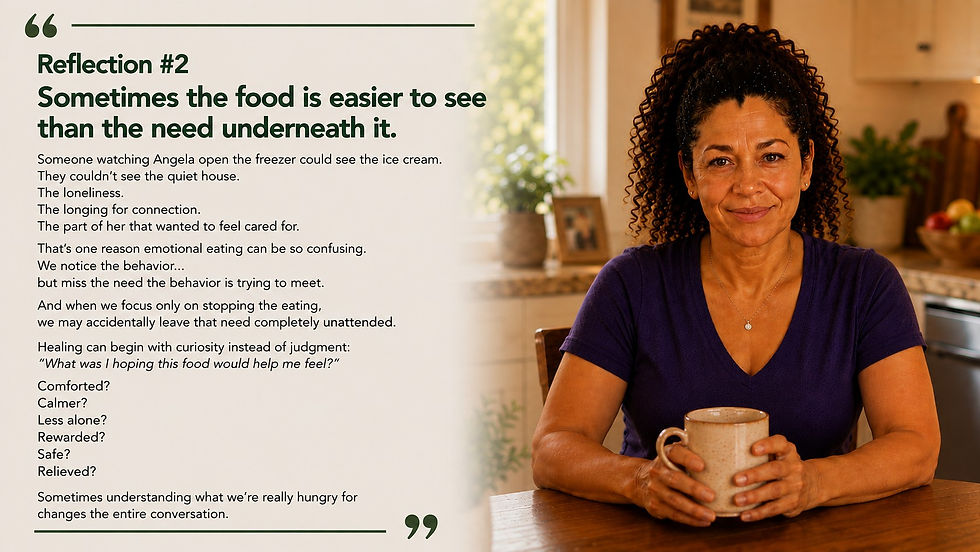
When eating triggers harsh self-criticism, food can take on a second role. The first eating moment may have been pleasure, celebration, convenience, or simply an ordinary choice. But afterward, disappointment and self-judgment can create an entirely new emotional experience—and another desire for food may emerge in response to that. This can create a painful loop in which eating leads to criticism, criticism increases distress, and food becomes appealing again because it has the capacity to soothe. Understanding that sequence isn't about blaming thoughts for eating. It's about becoming curious about what the desire for food may be trying to help with in that particular moment. The story explicitly distinguishes the cupcake from the cascade of self-critical thoughts that followed it.
You Don’t Have to Start Over After Eating More Than You Planned

All-or-nothing thinking turns eating into a test: as long as everything goes according to plan, we are succeeding; once something doesn't, the entire day can feel lost. But real life includes celebrations, changing plans, pleasure, stress, hunger, convenience, and unexpected food. Flexibility means allowing one experience to remain one experience instead of requiring it to determine everything that follows. The question “What would I like my next choice to be?” isn't a demand to compensate for what was eaten or immediately make a “better” food choice. It simply returns the future to the present moment. Angela's shift is precisely from “Did I ruin today?” toward recognizing that another choice remains available.
If one unplanned eating choice often turns into “I blew it,” “I ruined today,” or “I'll start over tomorrow,” the struggle may involve more than food. Therapy can help you understand the thoughts, emotions, needs, and patterns that can make emotional eating feel so difficult to interrupt—without reducing the work to another set of food rules. Learn more about our Emotional Eating Therapy services and how we help adults develop a more compassionate understanding of what may be happening underneath these patterns. One moment does not have to become a verdict about you, and it does not have to decide what happens next.


Comments