
Why Can't I Stop Thinking About What I Said Yesterday?

Have you ever replayed a conversation long after everyone else seemed to have forgotten it? You remember what you said, how someone looked at you, the pause before they answered—and suddenly a thirty-second interaction feels much bigger than it did at the time.
Sarah knows that feeling well.
It Was Just One Sentence

Yesterday, Sarah said something during a staff meeting at the hospital.
Nothing dramatic. Just one sentence.
She barely thought about it at the time.

But the next morning, it was the first thing she thought about when she opened her eyes.
Why did I say that?
When Your Mind Won't Let the Conversation Go

Driving to work, Sarah replayed the conversation.
Again.
And again.
And again.

Did everyone think I sounded stupid?
Maybe I talked too much.
Maybe they all noticed.
Everything Looks Normal--Except Inside Sarah's Head

The strange part?
No one had mentioned it. No awkward emails. No strange looks. Nothing.
But Sarah's mind refused to let it go.

As she walked through the hospital hallway, her coworkers smiled. Someone waved. Someone asked how her evening was.
Everything appeared completely normal.
Except inside Sarah's head.

She started replaying every word. Every facial expression. Every pause.
She even wondered if she had smiled too much—or not enough.
When a 30-Second Conversation Becomes a Two-Hour Movie

By lunchtime, yesterday's thirty-second conversation had become a two-hour movie.
Playing over...
and over...
and over...
When Overthinking Starts to Feel Like Evidence

That evening, Sarah finally told her husband:
“I think everyone probably thinks I'm an idiot.”
He looked confused.
“What are you talking about?”
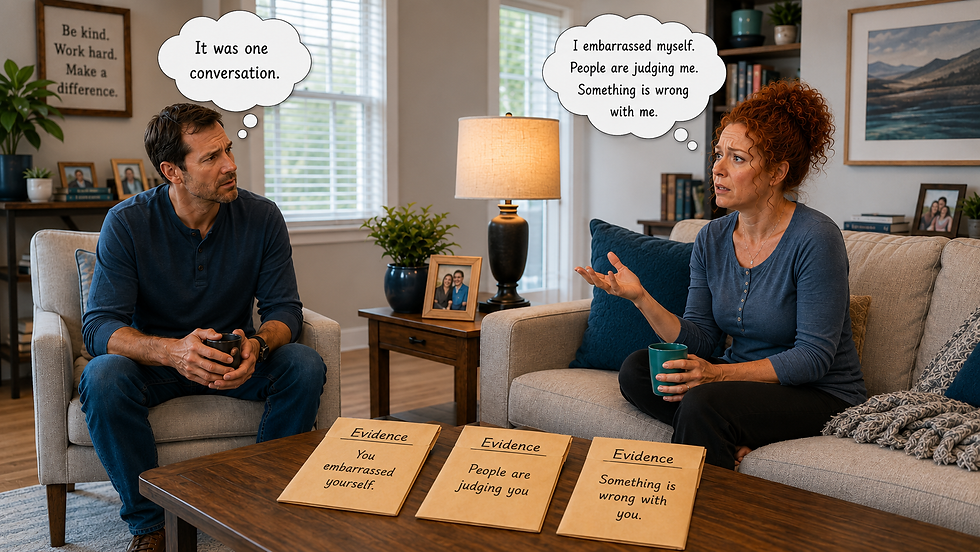
To him, it was one conversation.
To Sarah, it felt like evidence.
Evidence that she embarrassed herself.
Evidence that people were judging her.
Evidence that something was wrong with her.
Meet Sarah's Security Agent

Imagine having your own Secret Service Security Agent whose only job is to watch for signs that you might be rejected.
Every conversation gets reviewed.
Every mistake gets investigated.
Every awkward moment gets filed away.

But Sarah's Security Agent isn't trying to make her miserable.
It's trying to protect her.
If it can spot rejection before it happens, maybe she won't get hurt.
When the Alarm System Becomes Too Sensitive

The problem is that Sarah's Security Agent has become too sensitive.
It mistakes uncertainty for danger.
It mistakes awkwardness for rejection.
It mistakes being human for failure.

Sarah doesn't keep replaying yesterday because she's weak. Or dramatic. Or “crazy.”
Her anxious mind believes that replaying the conversation will somehow keep her safe next time.
What If Your Mind Isn't Broken?

Healing didn't begin when Sarah finally stopped replaying conversations.
Healing began the day she understood why she was replaying them.
Because when you understand what your mind is trying to do, you can begin responding with compassion instead of criticism.
Maybe my mind isn't broken. Maybe it's trying to protect me.
Before You Go: Three Things to Reflect On
Reflection #1--Maybe Your Mind Is Looking for Safety

When you replay a conversation over and over, you may not really be searching for the truth. You may be searching for certainty—the reassurance that you're still safe, accepted, and okay. But repeatedly searching the past for certainty can sometimes teach an anxious brain that there must have been danger there in the first place.
Reflection #2--Your Nervous System May Remember

Experiences with rejection, criticism, or painful mistakes can teach the nervous system to stay alert long after the original experience has passed. Sometimes the question underneath “Did I say something embarrassing?” is actually something much deeper:
“Am I still safe with these people?”
Reflection #3--Stop Fighting the Security Agent

Trying to force yourself to “just stop thinking about it” may turn your anxious mind into an enemy. Sarah begins to relate to it differently:
Thank you for trying to protect me...but is there actual danger right now?
The goal isn't to shame the protective mind into silence. It's to help it relearn the difference between uncertainty and danger.
Understanding Your Anxiety Is a Place to Begin
If Sarah's story felt familiar, you aren't alone. Overthinking can make ordinary interactions feel as though they need to be solved, reviewed, and understood before your mind can finally rest.
Understanding what your anxious mind is trying to protect you from can be the beginning of responding to yourself differently.
Learn more about how we help people understand and manage anxiety at A Helping Hand of Wilmington.


Comments